Knife types
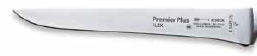
BONING KNIFE
The boning knife is suitable for removing bones, fat and gristle. Its flexible blade means that the knife adapts so well to the item you are cutting that you remove neither too much nor too little.
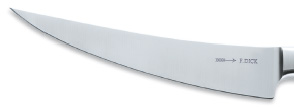
CARVING | BUTCHER’S KNIFE
This knife is suitable for cutting up large pieces of meat. Thanks to its curved blade, the edge is longer than on a straight knife, allowing you to easily pull the knife smoothly through the foodstuff.

CARVING KNIFE
The smooth edge and thin blade cut roasts, meat and ham with ease into perfect, thin slices, while minimising valuable lost juice.

CARVING KNIFE WITH SERRATED EDGE
The zig-zag serrated edge quickly and easily cuts crusts and crackling, for example on roasts. This knife is also eminently suitable for fruit and veg with hard, thick peel.
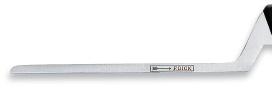
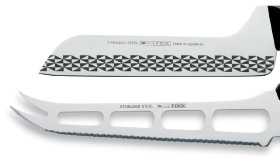
CHEESE KNIFE
The specially etched blade means that even soft cheese doesn’t stick to the blade. The angled handle means that there is a lot of space between the hand guiding the knife and the cutting board.
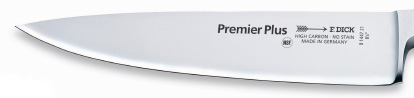
CHEF’S KNIFE
This is the classic knife, the heart of the professional kitchen. It is one of the most important utensils you can own due to its sheer versatility. It can be used for cutting herbs and vegetables, as well as cutting up meat and fish.
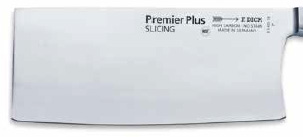
CHINESE CHEF’S KNIFE | CHOPPER | SLICER
This special chef’s knife is the most important knife in Asian cuisine. It is suitable for cutting vegetables, herbs, lettuce, fruit and poultry. The chopper, with its wide spine, is eminently suitable for chopping up large pieces of meat – particularly poultry – and for finely dicing vegetables. The thinner Chinese chef’s knife, the slicer, is suitable for finely cutting herbs and vegetables, as well as meat and fish.
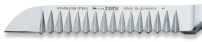
DECORATING KNIFE
This is used for prettily cutting cylindrical vegetables such as cucumber or carrots, fruit, butter or cheese into attractive, rippled slices.

FILLETING KNIFE
The thin, fine, flexible blade makes it easy to fillet meat and fish as well as removing skin and small bones. Fillets look like they should look; precisely cut and tasty.

HAM SLICER
No matter whether Serrano, Iberian or Parma ham, the flexible blade glides safely and effortlessly through it. The easy-to-guide blade makes it easier to cut wafer-thin, tasty slices, because the taste can only be properly appreciated with thin slices.
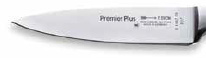
PARING KNIFE
Small, sharp and nimble; the paring knife is a versatile, indispensable utensil. It can be used for peeling, finely cutting, and decorating.

SALMON SLICER
Sliced salmon and ham look and taste better cut wafer thin. This knife has a flexible blade with a granton edge.
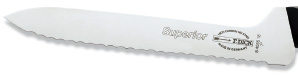

SANDWICH | BREAD KNIFE WITH SERRATED EDGE
This knife has a zig-zag serrated edge for all types of soft and hard bread, enabling you to cleanly cut perfect, uniform slices.
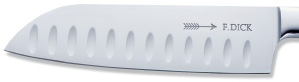
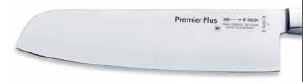
SANTOKU | USUBA
These knifes are the Asian classics for vegetables, fish and meat. Santoku and Usuba are characterized by a thin blade with a granton edge. The sharp heel is used for decorating.
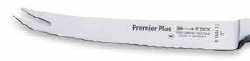
TOMATO KNIFE WITH SERRATED EDGE
This knife cuts items smoothly and without squashing them. The fine waves mean you can cut even difficult, delicate items smoothly. Use the points to pick up the slices.
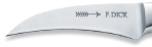
TOURNÉ PEELING KNIFE
This handy little knife is used for cutting, peeling or even decorating fruit and vegetables. The curved blade fits around the item to be cut, enabling you to cut quickly and effectively. You can use the tip to cut out brown spots, or the sprouting shoots on potatoes.
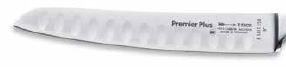
UTIILITY KNIFE WITH GRANTON EDGE
A utility knife is a special knife which can be used for almost anything in the kitchen. The indents on the blade create air cushions which minimize foodstuff adhering to the knife. Can be used for fine cutting.

UTILITY KNIFE WITH SERRATED EDGE
The sharp waves on the edge are ideal for cutting bread, crusts, cakes and peeling fruit and vegetables.
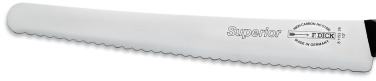
UTILITY KNIFE WITH WAVY EDGE
The rounded serrated edge is ideal for cutting gateaux, large fruit, and vegetables. The round waves create a clean cut with no raggedy edges.